
Centreville Previous Residents by Era
A Centreville address reaches back through several Fairfax sources, each with a different function. Deeds document a transfer and legal description. Tax books add annual owner or taxpayer context. Maps can show a road, parcel, or building change. Directories and census schedules may add a dated household clue. None should be treated as an uninterrupted roll of past residents. Start with the newest record that identifies the parcel, then choose the next source by the era of the Centreville question.
| Centreville source | Years it reaches | Where to use it | What it can establish |
|---|---|---|---|
| Centreville route: Fairfax land records and CPAN | 1742 to present | Circuit Court, CPAN, or public terminal | Transfers, parties, legal descriptions, consideration, plats, and prior-deed links |
| Centreville route: HRC deed indexes | 1742 to 1866 online; 1866 to 1942 physical | Historic Records Center | Names and deed-book references, with missing or incomplete books flagged |
| Centreville route: historic real-estate tax books | 1851 to 1980 | Historic Records Center | Owner or taxpayer and assessment context by year |
| Centreville route: iCare assessment data | Current | DTA web, phone, fax, mail, or office | Current owner, mailing versus situs, parcel, land, improvement, sales, and tax context |
| Centreville route: property maps and aerials | Map books annually from 1960; imagery from 1937 | Fairfax GIS tools | Parcel and visual change, not proof of an occupant |
| Centreville route: directories and telephone books | Exact local annual run not published | Virginia Room or Library of Congress reference route | Dated address-first subscriber or household leads where a volume exists |
| Centreville route: federal census | Public through 1950 in 2026 | NARA, library databases, and research centers | Household composition, relationship, age, birthplace, and census geography |
Use an assessment card for the current Centreville parcel, a deed for the last transfer, and a tax book or map to bridge older periods. For a household question, add a directory or census observation only after the address and era fit. Note: A missing local directory year is a gap in evidence, not proof that no one lived at the Centreville address.
Freeze a Centreville Address First
Before looking for past Centreville occupants or owners, preserve the present Centreville identifier in several forms: the iCare situs address, tax-map or parcel number, subdivision, lot or block, legal description, and current owner. Keep the owner mailing address on a separate line. The situs is the physical Centreville parcel; the mailing address is tax correspondence and may lead elsewhere. Confirm the street and parcel in MAR or Jade because a postal city label or ZIP can be broader than the Centreville CDP.
That small record set prevents a common error: searching a past owner only by a modern street number. Older Centreville deeds can refer to a tract, farm, route, adjacent owner, or subdivision instead. The legal description and plat often remain useful after the address line has changed. A present owner can also hold title through a trust, estate, corporation, marriage, or a name variant, so record the exact legal form before starting a deed search.
Trace Centreville Previous Residents Through Deeds
The deed chain supplies the ownership backbone for a Centreville address. It is a chain of transfers, not a direct list of everyone who lived there. In Fairfax, search the current owner as grantee, isolate the acquisition deed by date, legal description, parcel, or instrument reference, then use its seller and prior-book citation to move back. The grantor-to-grantee pattern matters because an address can disappear from older records while the legal description persists.
- Pull the current Centreville owner, situs, tax map, subdivision, and legal description from iCare, then validate the site in MAR or Jade.
- At CPAN or a public Research Room terminal, search the current owner as grantee and select the deed that matches the Centreville parcel and acquisition date.
- Record the grantor, grantee, recording date, instrument or book and page, consideration, legal description, and each prior-deed reference.
- Search the seller as an earlier grantee. For a trust, estate, corporation, married couple, or variant spelling, try every legal name shown in the document.
- Repeat until the Centreville legal description changes, the parcel becomes part of a subdivision, or the index changes to an older access channel.
- Grantor / grantee
- The grantor transfers an interest; the grantee receives it. In a backward Centreville chain, the seller on one deed is often the next earlier buyer to search.
- Chain of title
- A sequence of recorded transfers for the same land. It tracks ownership interests, not every person who used or occupied the address.
- Legal description
- The land description in a deed, often using a tract, lot, block, plat, or boundaries. It is more durable than a modern Centreville street number.
The Fairfax CPAN land-record route is a Centreville access path for the index and available images.
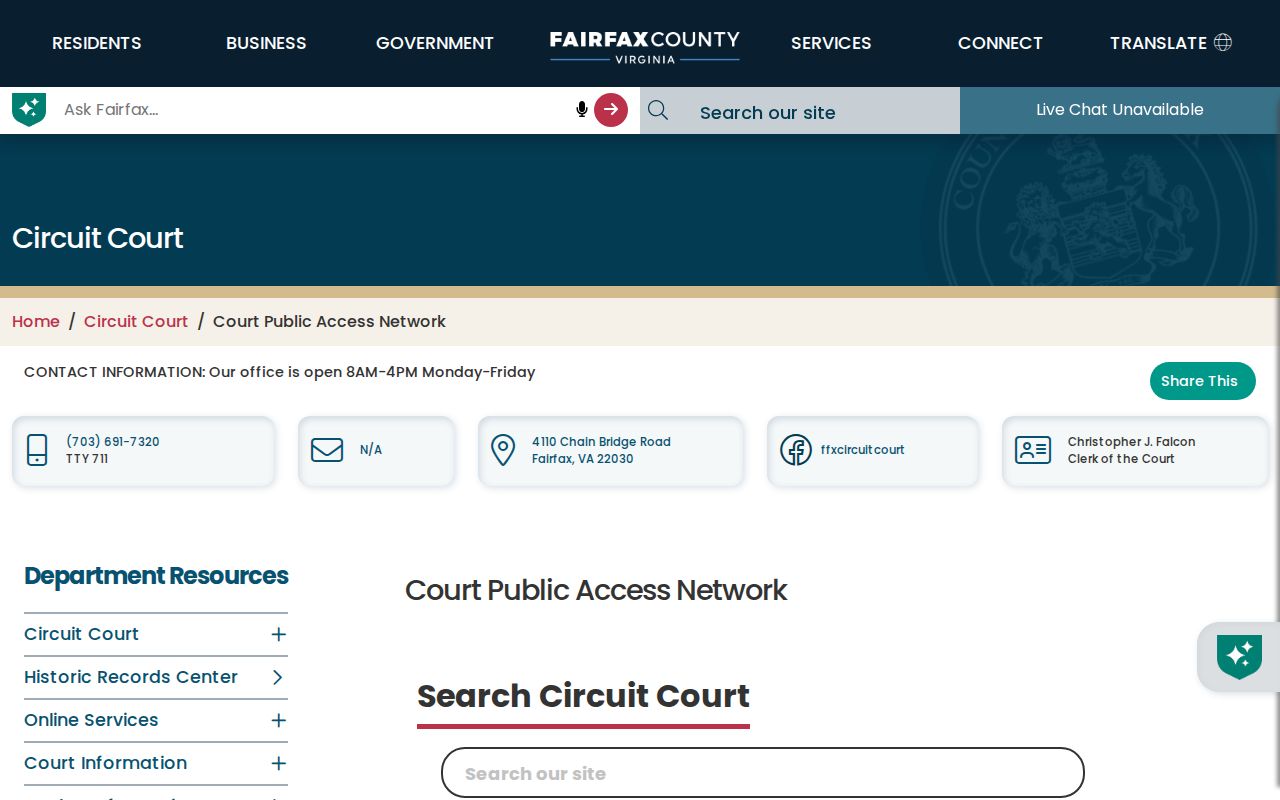
Use the Centreville instrument number or book and page from one deed to keep the next Centreville record search tied to the same land.
Centreville Past Residents and Index Changes
Fairfax land records reach 1742, but the Centreville search route changes by era. The Historic Records Center holds original deed books from 1742 through 1942. Its alphabetic online deed-index PDFs cover 1742 through 1866, while physical indexes cover 1866 through 1942. The Land Records Division and CPAN handle the post-1942 path. CPAN’s subscriber package describes wide index and image access, but remote availability is not the same as free public image access.
At the changeover, use the courthouse public terminals or HRC instead of abandoning the Centreville chain. Missing and incomplete deed books are flagged in the HRC index. That distinction matters. A missing volume cannot support a conclusion that a Centreville transfer never happened. The court can provide certified copies for $2 per document plus $0.50 per page; non-certified copies are available through CPAN or the counter route.
The Fairfax Land Records Research Room is the public-terminal and counter fallback for a Centreville deed search.
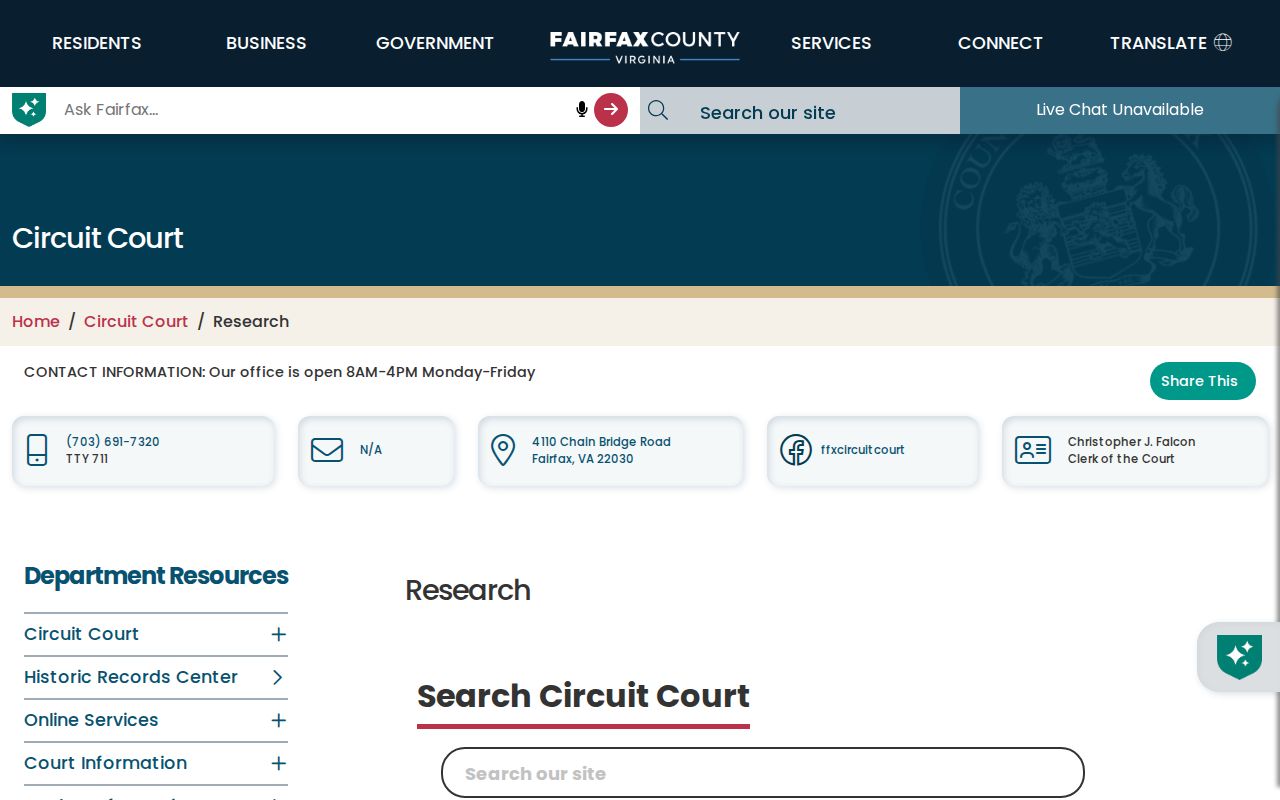
The Research Room gives a Centreville researcher an in-person Centreville path when a historic index, image, or copy is not available remotely.
Note: A Centreville counter request works best with an instrument number, book and page, tax map, or legal description.
Centreville Past Residents in Tax Books
Fairfax HRC real-estate tax books cover 1851 through 1980. They are especially helpful when a Centreville deed does not transfer each year and a directory has no confirmed local run. A tax-book entry can place an owner or taxpayer with property assessment context in a particular year. It does not certify title, and it does not prove that the named person lived at the Centreville address. Pair it with the deed’s legal description, a map, or a dated directory entry.
Fairfax also has a reconstructed 1890 Census spreadsheet based on court records because the federal 1890 schedules were destroyed. That distinctive local substitute can suggest a Centreville family lead, but it should be checked against the underlying court, tax, deed, or other record where possible. The HRC also warns that most loose papers before 1865 are missing because of Civil War looting and fire. A missing Centreville record series is not the same as a missing person.
In 2025, a Library of Virginia preservation grant funded conservation of the 1879 Atlas of Fairfax County and the 1892, 1900, and 1910 land-tax books. If a Centreville image is unavailable, ask HRC whether conservation work affects access before assuming the material was lost.
Note: Centreville tax-book evidence adds a year and a taxpayer, but it does not replace the recorded title trail.
Date a Centreville Address with Maps
Maps can date physical change around a Centreville address without naming a past household. Fairfax GIS historic imagery reaches back to 1937, and the Digital Map Viewer has annual property-map books from 1960. Use the time layer to compare a road, building footprint, subdivision layout, or nearby feature. Use a plat for a lot or block relationship. Fairfax PLUS can add an address, parcel, project, applicant, contractor, review, inspection, or status timeline. Each is evidence of a map or project event, not proof of residency.
Do not substitute a Sanborn image from another Centreville. The Library of Congress result found during research was for Centreville, Queen Anne’s County, Maryland, not Fairfax County, Virginia. No Centreville, Fairfax County Sanborn run was verified. The local alternatives are Fairfax property-map books, historic aerial imagery, plats, and the Virginia Room’s maps. For a fuller route among those sources, use the Fairfax property-history guide.
The official Centreville property-history guide connects the map, tax, deed, and directory portions of a house-history search.
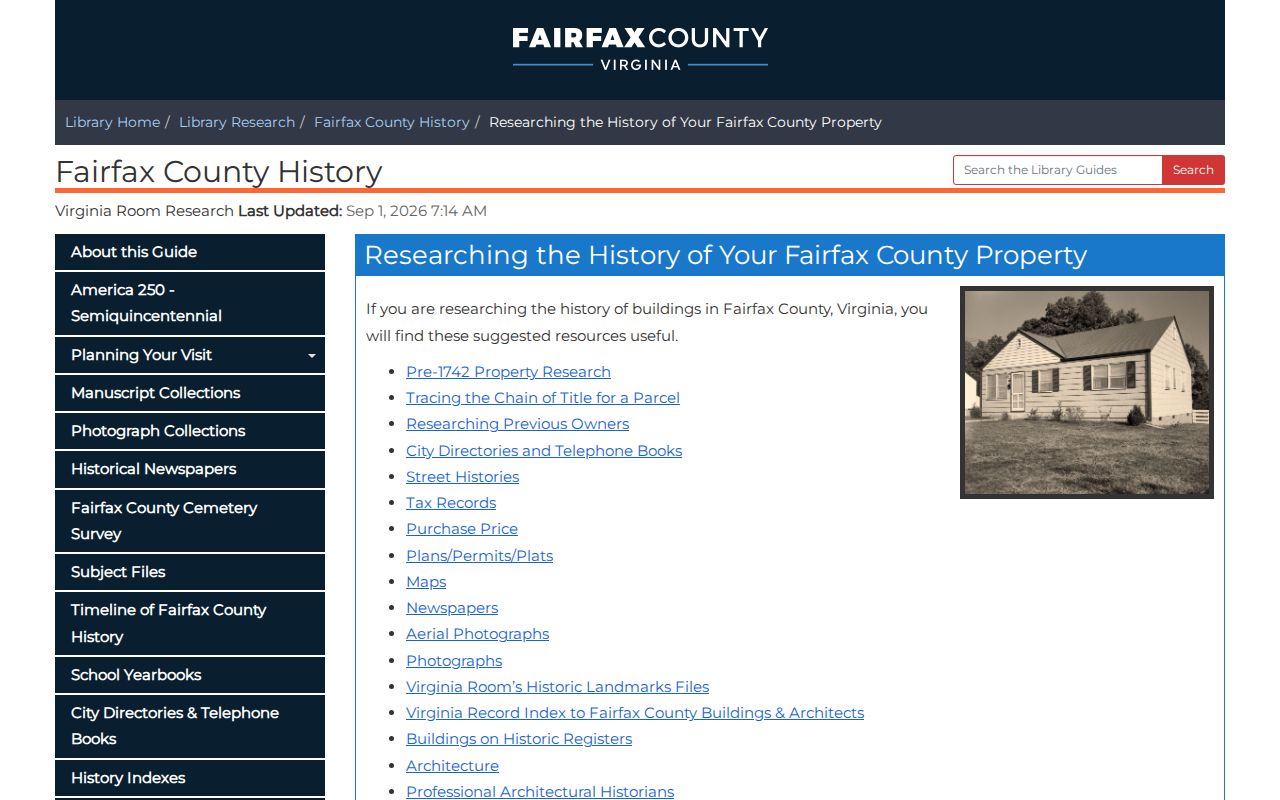
Its source categories help keep map-based Centreville dating separate from a documented Centreville past-household finding.
Note: Centreville aerial and map evidence can date visible change without proving who lived at the address.
Centreville Past Residents in Directories
Deeds show title parties. To ask who lived at a Centreville address, look for a dated address-first criss-cross directory, city directory, telephone book, census schedule, newspaper, or obituary. The Virginia Room is the local research desk for city directories and telephone books, maps, newspapers, manuscripts, yearbooks, and county records. Exact Centreville and Fairfax annual directory runs were not published in the official web material, so request the directory type, locality, and year rather than claiming an unverified continuous series.
- Find the Centreville address in a reverse or criss-cross volume, if the Virginia Room confirms one for the needed year.
- Record the Centreville spelling, initials, address, spouse notation, telephone, and any other printed entry detail exactly as it appears.
- Compare nearby Centreville directory years rather than jumping between distant decades. Publication year can reflect information collected earlier.
- Pair the Centreville address or household name with the federal census. The latest public census is 1950 in 2026, and Centreville geography may be recorded as a township or precinct.
- Confirm an important Centreville household lead through a deed, probate file, marriage or death record, yearbook, or contemporaneous newspaper item.
The Virginia Room has a CPAN station and microform readers that can print or save scans to USB.
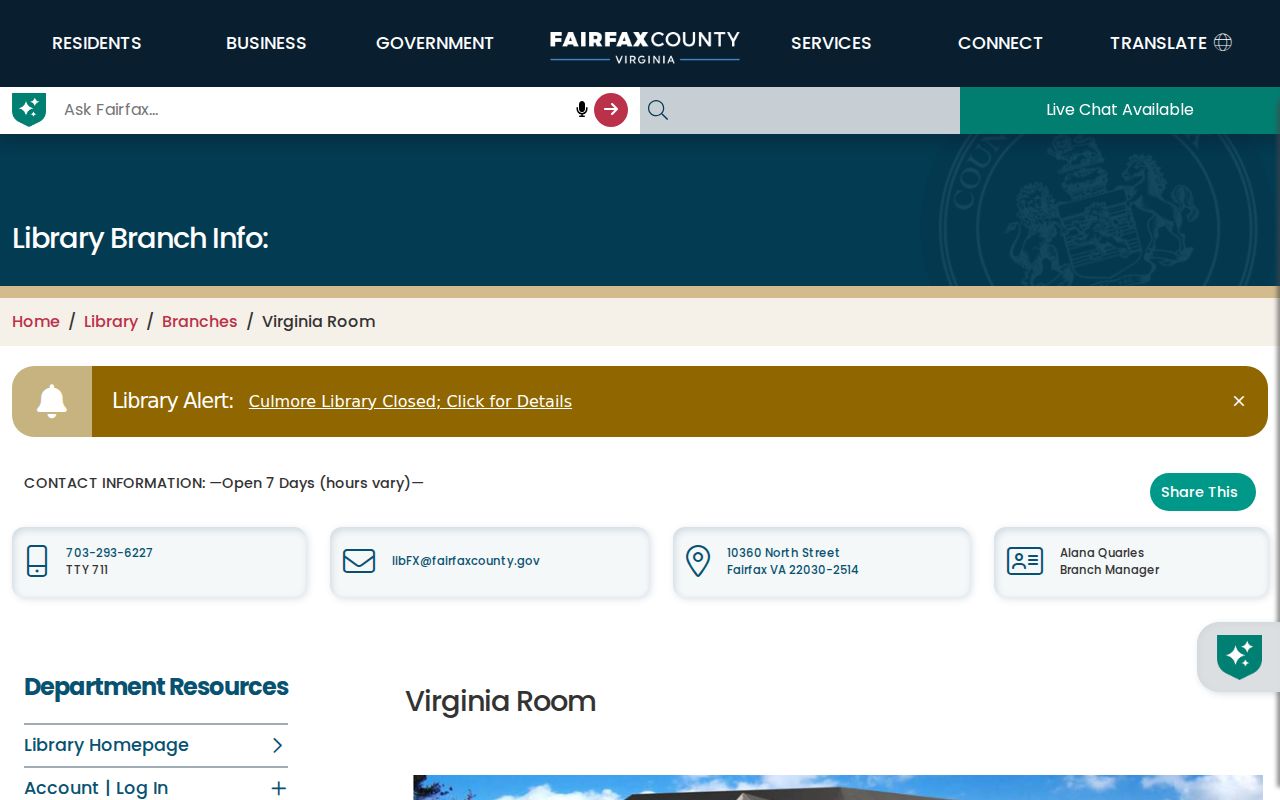
The Virginia Room offers an in-person Centreville route when a Centreville directory, newspaper reel, or older deed image cannot be viewed from home.
The Centreville city directory page discusses the collection side in more detail; the key task here is placing a household clue into the address’s backward timeline.
Lawful use. Centreville house-history and family-history research should respect living people and protected records. Never use a past-address finding to stalk, harass, intimidate, or harm anyone.
Centreville Past Residents at Trail End
Obituaries and probate can close or clarify a Centreville record trail. A Centreville newspaper notice may provide a death date, family relationship, last residence, or funeral information. A probate file can contain a will, inventories, accountings, fiduciary bonds, guardianship material, and names or addresses of heirs or fiduciaries, subject to sealing and redaction rules. Fairfax Probate has CPAN material for post-1935 records; HRC holds original will books through 1965 and indexes through 1935.
Use those records as a dated Centreville endpoint, not as a shortcut around privacy. Fairfax birth and death registers have documented gaps: 1853 through 1869 is present, certificates resume in 1912, and no official local birth or death recording is documented for 1861 through 1865 or 1897 through 1912. Marriage originals and registers cover 1853 through 1957. A Centreville research note should state the gap and seek another source instead of filling it with a guess.
Centreville Address Evidence and Gaps
No official source inspected supplied a dated Centreville street-renumbering project or a renamed-street list. That is a documented Centreville research gap, not evidence that Centreville addresses never changed. For an old no-hit, try Newgate or other historic place terms, route numbers, farm or tract names, a subdivision and lot, old owners, adjacent tracts, tax maps, plats, and historic aerials. Centreville developed from a crossroads village and rural land into later subdivisions, so the same ground can carry several geographic labels.
Historic landmarks can also bridge a Centreville legal description to a modern map. The Historic Centreville Society preserved the 1737 Willoughby Newton boundary stone and Lane’s Mill ruins, while local Centreville map and walking-tour material identifies Mount Gilead and other village anchors. Use a landmark as a search term only when it appears in the deed, map, or source at hand. It is a lead, not a replacement for the Centreville parcel record.