
Centreville Directory Collection Routes
Centreville has no documented municipal directory series. The practical shelf is the Fairfax County collection at the Virginia Room, where city directories and telephone books are listed among local-history resources. Ask for a locality, directory type, and exact year. That matters here because the public collection description does not expose a complete Centreville or Fairfax title-by-title run. It also prevents a Fairfax City volume from being mistaken for proof that it covered Centreville, a separate county community.
| Collection | Years | Where Held | Access |
|---|---|---|---|
| Centreville and Fairfax County city directories and telephone books | Exact local runs not published | Virginia Room, City of Fairfax Regional Library | Ask by locality and year; use catalog and reference help |
| Hill's Fairfax City, Virginia Directory lead | 1963 | Virginia Room local-history holdings; Virginia DHR survey citation | Adjacent-place lead only; inspect volume coverage |
| Reverse or criss-cross directories | Library of Congress inventory: 1930-2005 nationally | Library of Congress; possible Centreville-area Virginia Room volumes | Request type, locality, state, and exact year |
| Centreville, Virginia Collection MSS 03-04 | 1840-1977 | Virginia Room / ARVAS catalog | No restrictions; consult repository |
| Historic Centreville newsletters and newspapers | Millrace sampler: 1985-2023 | Historic Centreville Society and Virginia Room resources | Use Centreville names and events as leads; verify publication date |
There is no verified digitized Centreville directory collection in the material reviewed. The Library of Congress telephone-directory collection describes a broad national resource, but its published state coverage does not include Virginia. A missing Centreville online result therefore calls for the library, a Library of Congress request, or a catalog search, not a claim that the household was absent.
Centreville City Directory Shelf at Virginia Room
The Fairfax County Public Library Virginia Room is the main historical research desk for Centreville. It is on the second floor of City of Fairfax Regional Library, 10360 North Street, Fairfax, VA 22030-2514. Call 703-293-6227, option 6, or email va_room@fairfaxcounty.gov before a Centreville visit when a particular directory year matters. Beyond directories and telephone books, its Fairfax and Northern Virginia materials include maps, photographs, local newspapers, rare books, subject files, school yearbooks, oral histories, and manuscripts.
Its access tools make the room more than a shelf. Eight internet stations, a designated CPAN station, and a microform reader-printer with USB saving can bridge a Centreville directory entry to a deed, a newspaper reel, or a scanned item. Rare materials require care, and food or beverages are not allowed. A concise Centreville request, such as a street, address, organization, surname, and time period, gives staff a workable starting point.
See the Virginia Room collection overview before beginning a Centreville request.
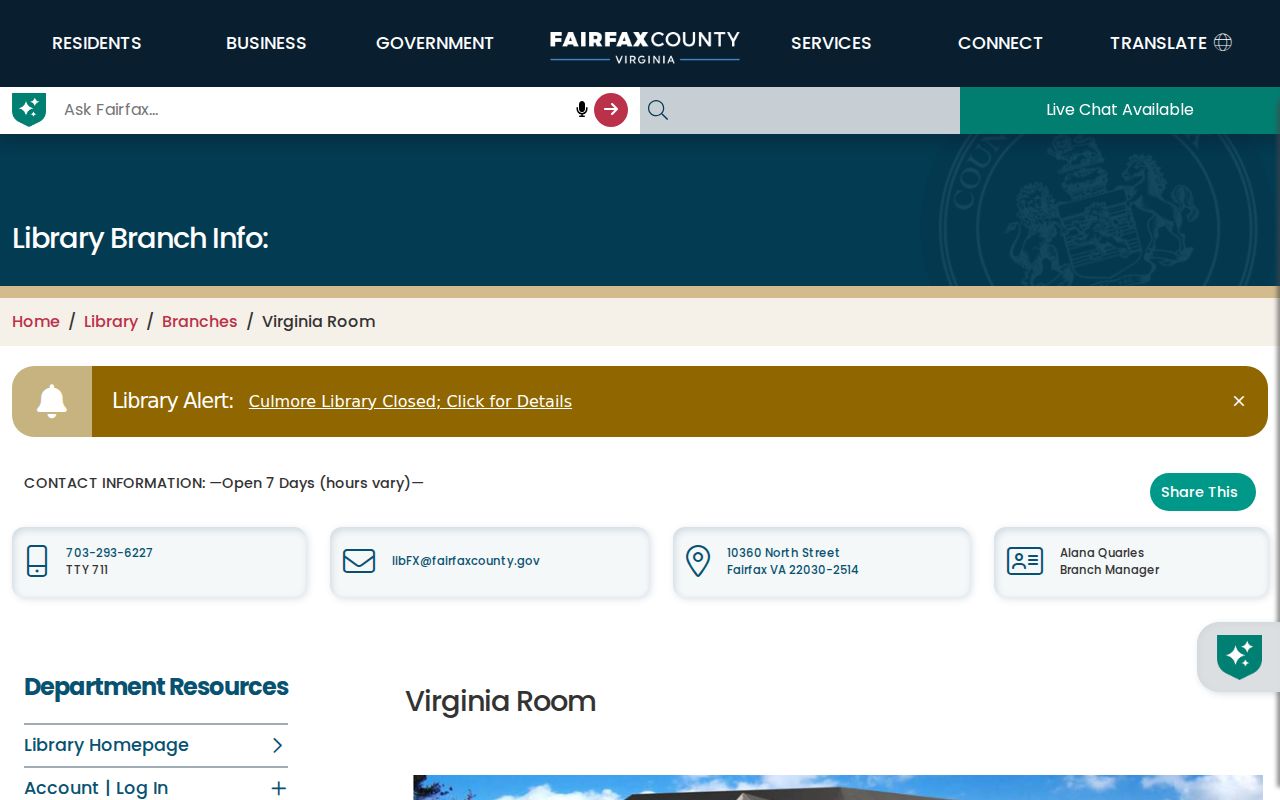
The room's directory, map, and microform resources provide the offline route when a Centreville name search has no remote Centreville image.
Note: The public description confirms the resources, but it does not publish every Centreville directory title, publisher, or year on the shelf.
Centreville's 1963 Directory Lead
A Virginia historic-property survey cites Hill's Fairfax City, Virginia Directory, published in Richmond by Hill Directory Co. in 1963. That citation is a solid Centreville research lead, not a continuous run and not evidence that every entry lies in Centreville. The City of Fairfax is an independent jurisdiction even though it is the county seat. Check the title page, geographic coverage, and street index before relying on an entry for a Centreville family.
When an old address is unclear, a Fairfax Digital Map Viewer can place a later Centreville parcel or street in historic property-map context. Its property-map series goes back annually to 1960, which may help distinguish a Fairfax City reference from a Fairfax County location. It cannot establish that a person lived at a Centreville address by itself.
Use the Digital Map Viewer as a place-checking source alongside the printed volume.
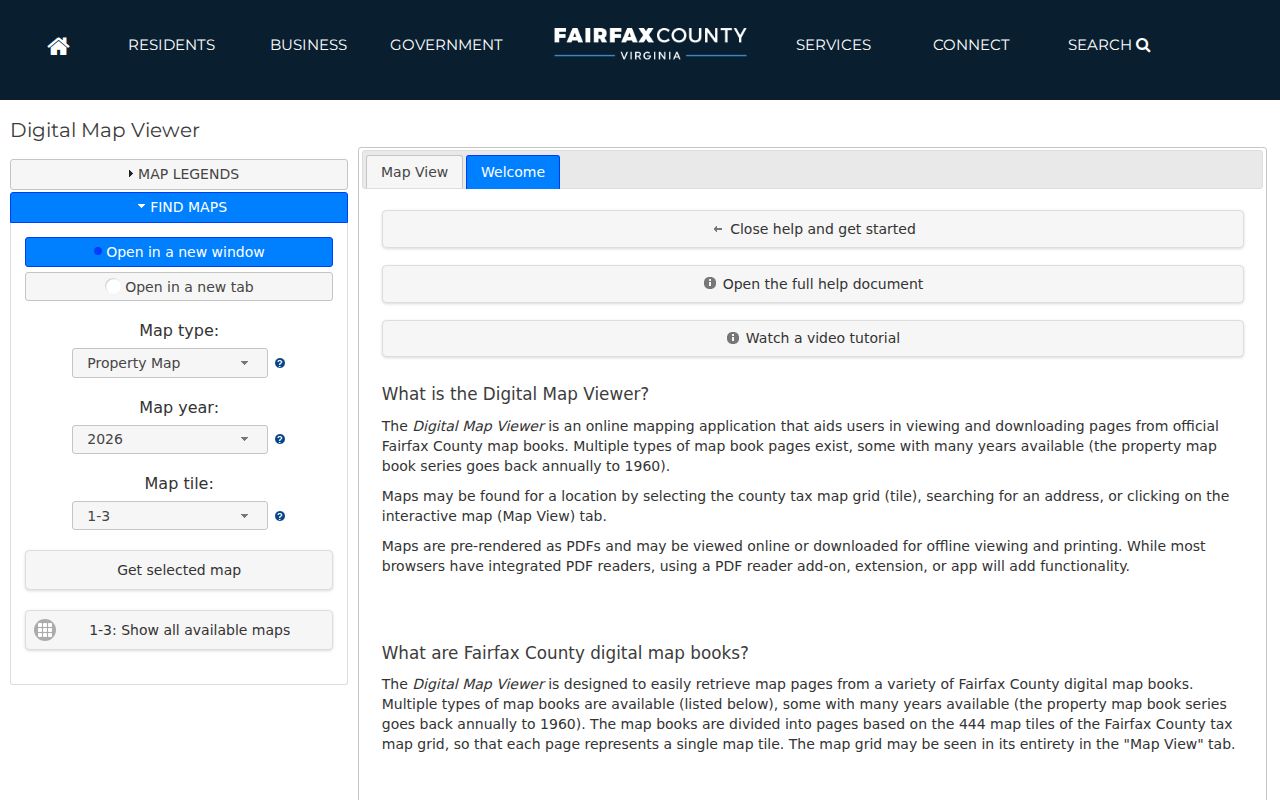
Map-year and tile controls can clarify the Centreville street and parcel setting around a directory address without replacing the directory's own printed evidence.
Reading a Centreville City Directory Entry
A historical entry is a dated publisher's observation, not a certified record. Local examples must be inspected in the volume, because the Fairfax/Centreville abbreviation key and sample image were not available in the public material. A Centreville researcher can still record the commonly printed elements below as a disciplined checklist. Keep the page or section number and the publisher's key with the Centreville transcription, especially where initials or relationship marks could change the identification.
| Printed name | Copy the Centreville surname, given name, initials, and spelling exactly. |
|---|---|
| Relationship notation | Note spouse or widow notation exactly when it appears. |
| Occupation or business | Record the stated activity, employer, or business only when printed. |
| Street address | Keep number, direction, street, apartment or unit, and any residence notation. |
| Telephone and household marks | Capture a number or marker only if that edition includes it. |
| Volume context | Save year, publisher, page or section, and the abbreviation key. |
- Criss-cross directory
- An address-first arrangement, generally organized by a Centreville street and house number before the subscriber or occupant.
- Householder index
- A name-based arrangement that may identify the person under whom a household was listed.
- Abbreviation key
- The Centreville publisher's explanation of shortened marks. Read it before assigning meaning to an initial or symbol.
Do not turn a name in a Centreville city directory into proof of ownership or a present address. Rural or unlisted addresses, recently moved families, apartment occupants, military households, and women listed through a spouse can be missed. The printed date may also follow the survey date.
Centreville Criss-Cross Directory Requests
For a Centreville address without a surname, request a reverse or criss-cross volume. The Library of Congress reverse-directory guidance defines this address-first arrangement and asks researchers to give the type, locality and state, plus an exact year. For Centreville, ask whether the Virginia Room has a street-address, criss-cross, telephone, or city-business volume for Fairfax County or the named community.
Read the street in sequence, then move to the name-first portion for relationship, address, or business clues. A Centreville street entry is most useful when paired with a map, tax book, or deed reference that fixes the place. The Library of Congress inventory covers national holdings from 1930 through 2005, but that range is not a verified local Centreville run.
Trace a Centreville Household by Directory Year
Following one Centreville household works best as a sequence rather than a single search. Record the full address and spelling before comparing years. Small changes can be meaningful: an initial becomes a given name, a spouse notation changes, a telephone entry disappears, or the same surname moves across a street. Pair each observation with an independent record. The public federal census currently reaches 1950, and its geography may use a precinct or township label rather than Centreville.
- Start with the exact Centreville address, including old spelling, direction, number, and unit. Use an address-first volume where one exists.
- Transcribe names, initials, relationship marks, address, occupation, telephone, and the page reference without expanding abbreviations.
- Compare adjacent Centreville publication years and note the volume date plus any stated data-collection cutoff.
- Pair the directory observations with the 1900-1950 federal census for household composition, relationships, age, birthplace, and occupation.
- Test the Centreville match through Fairfax deed indexes, probate, marriage or death indexes, newspapers, yearbooks, and business filings.
A disappearance can mean a move, a death, an unlisted number, a publisher's coverage change, or a different spelling. Treat it as a question. For a modern address-keyed record chain, use the Centreville street directory rather than trying to make an old printed listing answer a current parcel question.
Centreville Collection and Millrace Records
The Centreville, Virginia Collection MSS 03-04 gives the directory shelf a broader local setting. Held by the Virginia Room, it spans 1840-1977 and measures 0.5 linear feet. The abstract lists papers, reports, lecture notes, a hand-drawn land survey, a broadside, manuscript drafts, and a photocopied map. There are no stated restrictions, but access is by consulting the repository rather than assuming that each item is online.
The Historic Centreville Society, established in 1987, supplies another route to local memory through tours, preservation work, and The Millrace. Its selected sampler draws from issues dated 1985-2023. Names in newsletters can lead to an obituary, a deed description, a preservation file, or an oral-history question. They do not establish a current member list or a present household.
Centreville Directories Between Census Years
Fairfax's record history offers a useful companion to the Centreville city-directory trail. The Historic Records Center describes a reconstructed 1890 census spreadsheet made from Fairfax court records after the federal 1890 schedules were destroyed. That is a strong local story, but it is still a Centreville lead to be checked against the underlying court, tax, deed, or directory evidence. It can help bridge a Centreville family between directory observations when the ordinary federal census path breaks.
Historic tax books cover 1851-1980, and land records run from 1742 forward. Together, those collections can test whether a Centreville surname remained tied to a tract or changed addresses. Older deeds may describe roads, landmarks, farms, or adjoining owners instead of a modern street number, so carry forward every alternate place name found in a directory transcription.
Note: A missing early record series may reflect Civil War loss or an incomplete book, rather than evidence that the household never existed.
Centreville Directory Research and Preserved Tax Books
In 2025, Fairfax Circuit Court reported a $21,450.60 Library of Virginia preservation grant for the 1879 Atlas of Fairfax County and the 1892, 1900, and 1910 land-tax books. Those materials were picked up for conservation in June 2025. For Centreville family work, the preserved books are a place-and-owner layer that can sit beside a printed directory, a map, and the Historic Records Center's deed indexes. Check availability with the repository when a needed volume is unavailable.
The story also explains why a careful Centreville research log matters. Record the exact volume, year, page, map tile, and access channel. A Centreville collection may be in conservation, onsite only, in microform, or accessible through a designated terminal. That detail makes a later request reproducible without overstating what one directory entry proves.